In 2024, thousands of pages from Google's internal Content Warehouse surfaced online, giving SEO professionals an unprecedented look at the data types Google actually collects and stores. The documents were not a marketing blog post or a vague conference talk. They were real internal system specifications, and Google confirmed the leaked documents are authentic.
Think of Google's ranking system as an enormous spreadsheet. Every row is a page on the internet. Every column is a piece of data Google captures about that page, from how long visitors stay to whether the page includes a phone number. The leak revealed the column headers, meaning we now know what Google tracks. It did not reveal the formulas, meaning we still do not know exactly how each data type is weighted in the final ranking.
Nearly two years later, the implications remain highly relevant for local businesses and the marketers who support them. Below is a breakdown of the most important findings for local SEO, along with actionable steps you can take today using GMB Everywhere.
Business Information Google Collects
One of the most revealing models in the leak is GoogleApi.ContentWarehouse.V1.Model.LocalWWWInfo. This model shows that Google extracts structured business data directly from web pages, including physical address, phone number, business hours, latitude and longitude coordinates, and a confidence score indicating how certain Google is about each data point.
A critical detail: this data is collected per page, not per website. If your business details appear on your homepage but nowhere else, Google has fewer data points to confirm your information. Additionally, the leak revealed specialized data fields for verticals like travel, restaurants, hotels, and health insurance, suggesting Google applies industry-specific ranking logic on top of generic local signals.
What This Means for Your Local SEO
- Structured data (schema markup) matters more than ever. Implement LocalBusiness schema on every relevant page so Google can parse your name, address, and phone number with high confidence.
- Include business details on every page, not just your homepage. Your contact information, hours, and service area should appear in the footer or a consistent sidebar across your entire site.
- Place location information near the top of the page. The leak suggests Google captures content position, so prominent placement of your city and neighborhood helps reinforce local relevance.
User Behavior on the Page Matters
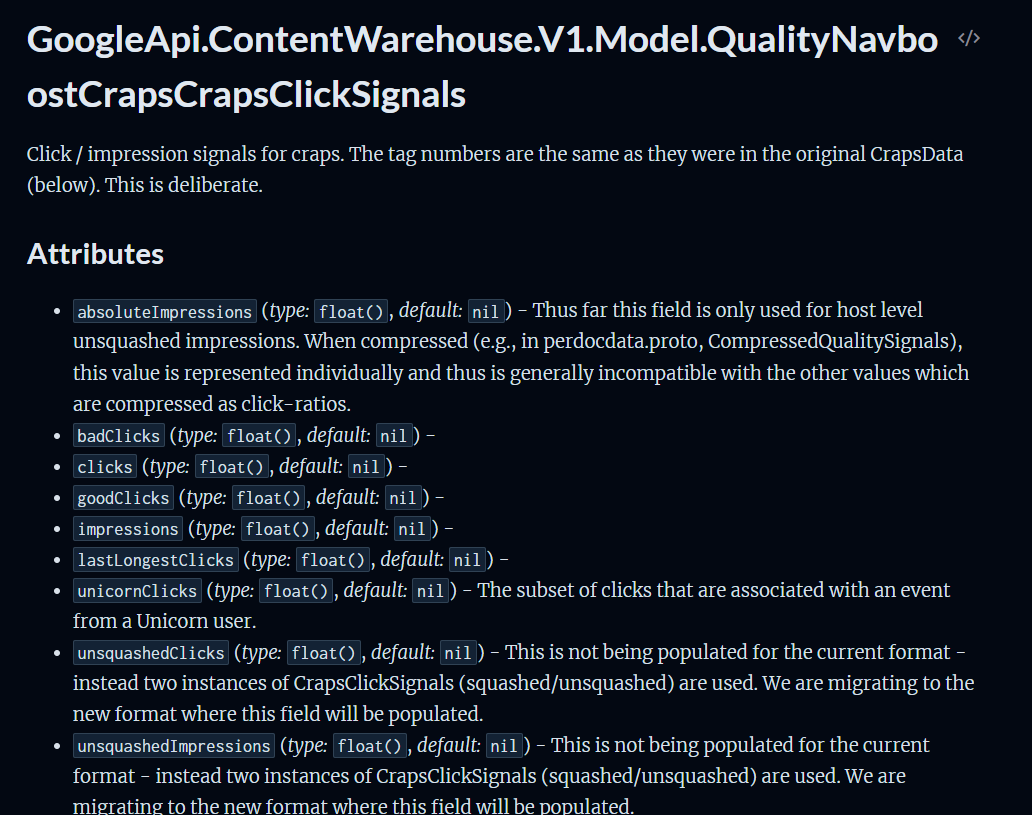
The leaked documents reference a model called GoogleApi.ContentWarehouse.V1.Model.QualityNavboostCrapsCrapsClickSignals. Despite the unusual name, this model confirms something many SEOs have long suspected: Google retains detailed click and engagement metrics for up to 13 months. That is more than a year of behavioral data per page.
The leak also shows that Google captures the geographic location of users who interact with a page. Combined with data from Chrome browsers, this gives Google a granular picture of which real people in which real locations find a page useful. Pages that attract clicks and sustained visits from users in a specific area gain a measurable advantage.
What This Means for Your Local SEO
- Keep navigation simple and intuitive. If visitors struggle to find what they need, they leave quickly and those short visits work against you for months.
- Create content that is genuinely relevant to your local audience. A page about "roof repair in Austin" should address Austin-specific concerns (hail damage, local building codes) rather than offering generic advice that could apply anywhere.
- Encourage real local engagement. When nearby users spend time on your pages, click through to services, and return later, Google's behavioral signals strengthen your position in local results.
Location Relevance
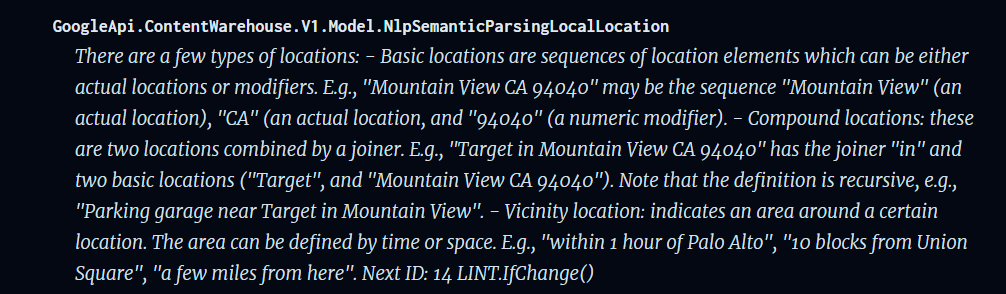
The leak reveals that Google assesses a page's geographic relevance even when the page does not explicitly mention a location. If Google cannot determine a specific location, it defaults to the country level, which is far too broad to help a local business compete in map results.
An in-depth analysis by iPullRank found evidence of a location demotion mechanism. Pages that fail to establish clear geographic relevance may be actively pushed down in local results rather than simply losing a ranking boost. The distinction is important: it is not just that location helps you rank higher, it is that a lack of location specificity can actively hurt you.
What This Means for Your Local SEO
- Add your specific city, neighborhood, or service area to every page. Do not assume Google will figure out where you are based on your Google Business Profile alone.
- Make each page relevant to a single location. If you serve multiple cities, create dedicated pages for each one rather than listing every city on a single page. Focused pages send a clearer location signal.
How Google Measures Topic Relevance
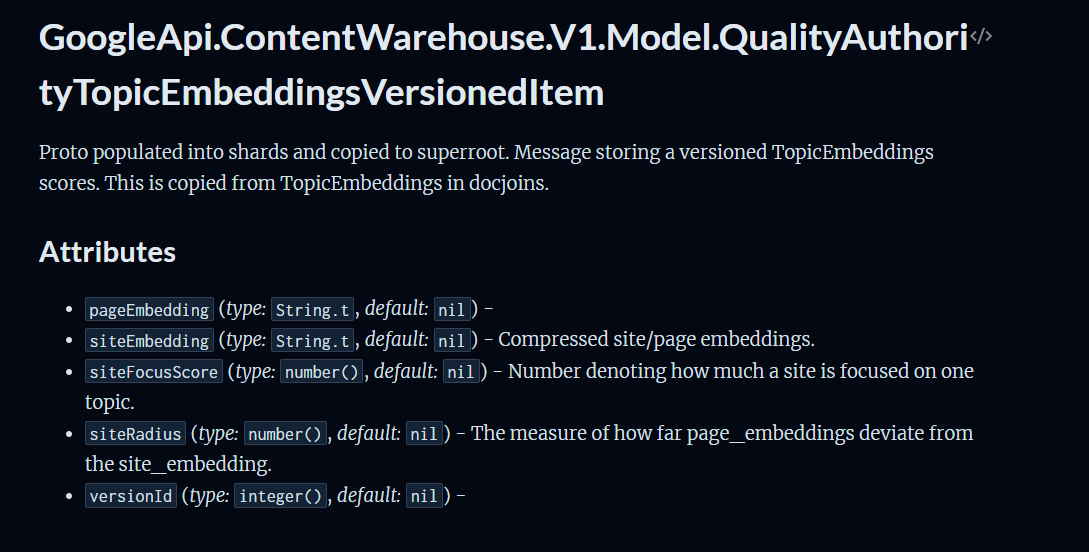
The leaked documents describe how Google converts pages and entire sites into mathematical vectors and compares them for topical consistency. A metric called siteFocusScores measures how closely each page aligns with the core topic of the overall site. A plumbing company's blog post about kitchen remodeling tips, for example, would score differently than a post about pipe repair techniques.
This confirms that topical authority is not just a theory. Google quantifies it. Sites that stay tightly focused on their area of expertise build stronger authority signals than sites that publish broadly unrelated content in an attempt to attract more traffic.
What This Means for Your Local SEO
- Create separate pages for each service category. Rather than listing all services on one page, give each its own dedicated page with detailed, relevant content.
- Keep every page on your site relevant to your core business. Random blog posts that have nothing to do with your industry can dilute your site's topical focus score.
- Build depth, not breadth. Ten well-written pages about your specific services will outperform fifty surface-level pages covering loosely related topics.
Frequently Asked Questions
Does the Google leak reveal the exact ranking algorithm?
No. The leak shows the data types and fields Google collects, not how they are weighted or combined. Think of it as seeing the column headers in a spreadsheet without seeing the formulas. It confirms what Google tracks, but not how much each factor influences your ranking.
Is the information from the leak still relevant in 2026?
Yes. The core data structures and collection methods revealed in the leak reflect long-standing infrastructure decisions, not short-term experiments. The business information models, user behavior tracking, and location relevance systems are foundational components that Google continues to rely on.
How can GMB Everywhere help me apply these findings?
GMB Everywhere lets you audit your Google Business Profile categories, analyze competitor profiles, and identify gaps in your local SEO setup. By understanding what data Google collects, you can use GMB Everywhere to make sure your profile and website provide that data clearly and consistently.
Conclusion
The Google leak did not uncover any single secret trick. What it did confirm is that the advice experienced local SEO professionals have been giving for years is grounded in reality. Structured business data, strong user engagement, clear location signals, and tight topical focus are not guesses. They are measurable data points inside Google's own systems.
The businesses that act on these findings consistently, auditing their profiles, tightening their content focus, and reinforcing their location signals on every page, are the ones best positioned for long-term local search visibility. GMB Everywhere gives you the data you need to put these insights into practice.